In this guide
- Block board has a core of solid wood strips, each no wider than 30 mm under IS 1659, faced with veneers on both sides.
- Plywood is built entirely from thin veneers laid with the grain crossing, made to IS 303 or IS 710.
- Block board is usually lighter and stays straighter on long doors, partitions and long panels.
- Plywood grips screws more evenly, which suits carcasses, drawers and hinge-heavy parts.
- Check block board for the ISI mark, the grade, gaps in the core and a straight edge before it is cut.
What is the difference between block board and plywood?
The difference is the core. Block board has a core of solid wood strips laid edge to edge, with veneers on both faces. Plywood is made entirely of thin veneers glued with the grain crossing. Block board suits long, flat parts like doors and partitions; plywood suits carcasses and screw-heavy parts. Sri Sri Plywoods can advise part by part.
Both boards look alike once they are laminated, which is why the choice is often left to the carpenter. The core decides how each one behaves over a long span, how it holds a screw, and how heavy it is to hang.
| Factor | Block board | Plywood |
|---|---|---|
| Core | Solid wood strips, each no wider than 30 mm | Thin veneers, grain crossing layer to layer |
| Indian Standard | IS 1659 | IS 303 (MR, BWR, BWP) or IS 710 (Marine) |
| Grades | MR and BWP | MR, BWR, BWP, Marine |
| Weight | Usually lighter, with a softwood core | Usually heavier for the same thickness |
| Long spans | Stays straight along the strip direction | May need a support on long shelves |
| Screw grip | Good into a strip, weak in a gap | Even across the sheet |
| Thicknesses often used | 19 mm, 25 mm | 6, 12, 18–19 mm |
| Typical uses | Tall doors, partitions, bed panels, long shelves | Carcasses, drawers, kitchen units, backs |
How is block board made?
IS 1659, the Bureau of Indian Standards specification for block boards, defines it as a board with a core of wood strips, each not more than 30 mm wide, glued between two or more veneers on each side. The grain of the core runs at right angles to the veneers next to it.
Strips of seasoned wood
The strips are cut from timber seasoned to 12% moisture content or less and placed edge to edge without significant gaps. Many makers use a softwood such as pine.
Veneers on both sides
Veneers are glued across the core on each face, so the board stays balanced and flat. Decorative types carry a better face veneer for polishing.
MR and BWP
IS 1659 has an MR grade for interior furniture, partitions and panelling, and a BWP grade for high humidity and external use.
8×4 ft and others
Listed sizes include 2440 × 1220 mm (8×4 ft), 2140 × 1220 mm, 2140 × 920 mm, 1830 × 1220 mm and 1830 × 920 mm.
IS 1659 also splits each grade into two types. The decorative type has a decorative face veneer on one or both sides, for furniture and panelling that will be polished. The commercial type has ordinary veneers on both faces and is meant for furniture that will be laminated or painted over.
Plywood, by contrast, has no solid core at all. Our guide to MR, BWR, BWP and Marine plywood explains how its grades work.
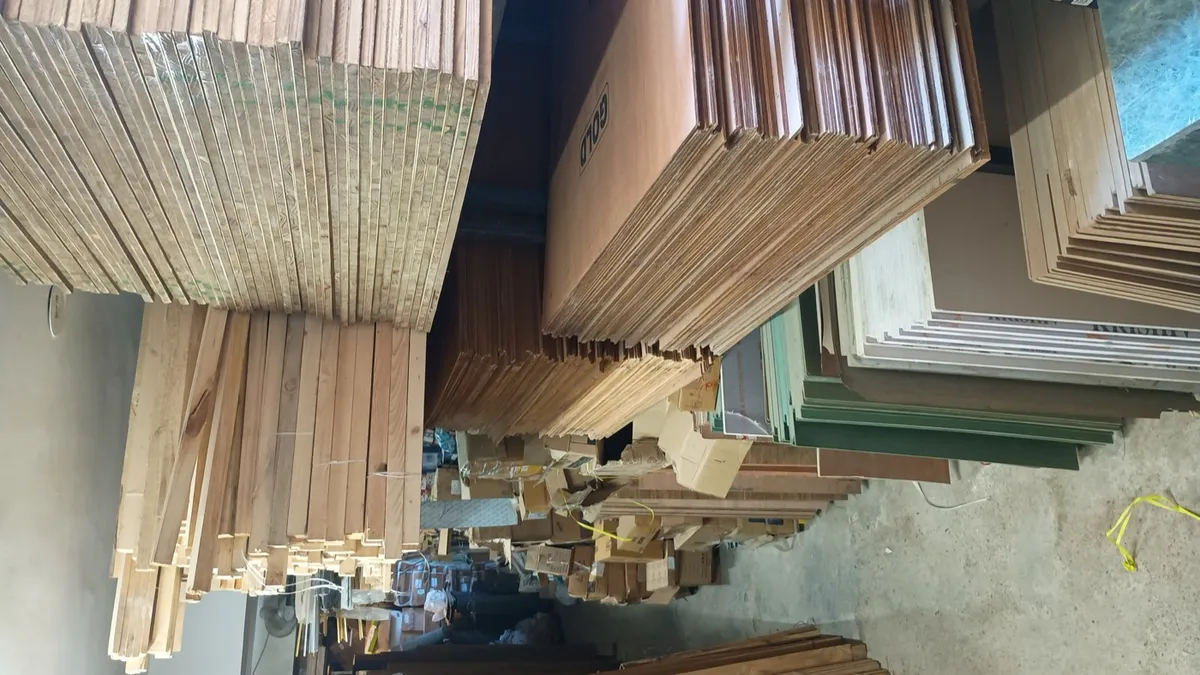
Is block board better than plywood for tall doors and shutters?
Block board works better for long, flat parts that must stay straight and not be too heavy: tall wardrobe and room doors, partitions, bed headboards and side panels, table tops and long shelves. The solid strips resist bending along their length. Sri Sri Plywoods suggests it where span matters more than the number of screws.
- Tall wardrobe shutters and sliding doors. A 7 ft door in block board is usually lighter and stays flatter along its length.
- Partitions and wall panelling. Long, flat runs benefit from the stiff core.
- Beds. Headboards, side rails and base panels are large, flat and mostly glued or bolted, not screwed at every edge.
- Long shelves and study tables. Cut so the core strips run along the length of the shelf; for heavy loads such as books, add a mid-support whichever board you use.
Where is plywood the better choice?
Plywood wins wherever a part carries many fixings, sees water, or is small and cut into many pieces:
- Kitchen carcasses. Hinges, channels and brackets go in at many points, and the sink base needs BWP plywood.
- Drawers and drawer boxes. Thin plywood sides hold their shape and take screws at the corners.
- Wardrobe carcasses and internal shelves. Screws at the edges hold more evenly in plywood.
- Bathroom vanities and balconies. Use BWP or Marine plywood; block board is not the usual choice here.
- Back panels. 6 mm plywood is the standard back for cabinets and wardrobes.
Water is the other deciding factor. IS 1659 does have a BWP grade of block board for high humidity, but for the sink base, a bathroom vanity or a balcony cabinet, BWP or Marine plywood is the usual choice. In a wardrobe on an external or bathroom wall that turns damp in the monsoon, pick the grade with that wall in mind, whichever board you use.
A practical mix is common: a plywood carcass with block board doors in a tall wardrobe, or a block board bed with plywood drawers underneath. If you are weighing up HDHMR for shutters instead, read HDHMR vs plywood.
Need today's rate?
Get a free quoteDoes block board hold screws as well as plywood?
Into the face, a screw that bites into a solid strip holds well. The weak spots are the small gaps between strips, and the edges, where a screw may run into the end grain of a strip or into a joint. A screw that lands in a gap can feel tight when fitted and then work loose under load.
Plywood behaves more evenly, because every layer is glued across the one below it. That is why hinge-heavy and channel-heavy parts are usually made in plywood.
On a block board door, the concealed hinge cup is bored into the face of the shutter, where it usually sits in solid strips and holds well. The hinge plate, though, is screwed into the carcass side, which is one more reason to keep the carcass in plywood.
Block board or plywood: which suits wardrobes, beds and doors?
| Part | Sri Sri suggests | Why |
|---|---|---|
| Tall wardrobe doors (7 ft and up) | Block board, 19 mm | Lighter, and stays straighter over the height |
| Wardrobe carcass | Plywood, 18–19 mm | Many screws at the edges |
| Bed headboard and side panels | Block board, 19–25 mm | Large flat panels, few edge screws |
| Bed drawers and storage boxes | Plywood | Corner screws and runners |
| Room partitions and panelling | Block board | Long runs that must stay flat |
| Long bookshelf | Block board, strips along the length | Resists sag; add a support for heavy loads |
| Kitchen carcass and sink base | BWR or BWP plywood | Water, steam and hardware |
| Cabinet backs | 6 mm plywood | Thin, light and easy to fix |
For more on how many sheets each of these needs, see how many plywood sheets you need.
How do you check block board quality before buying?
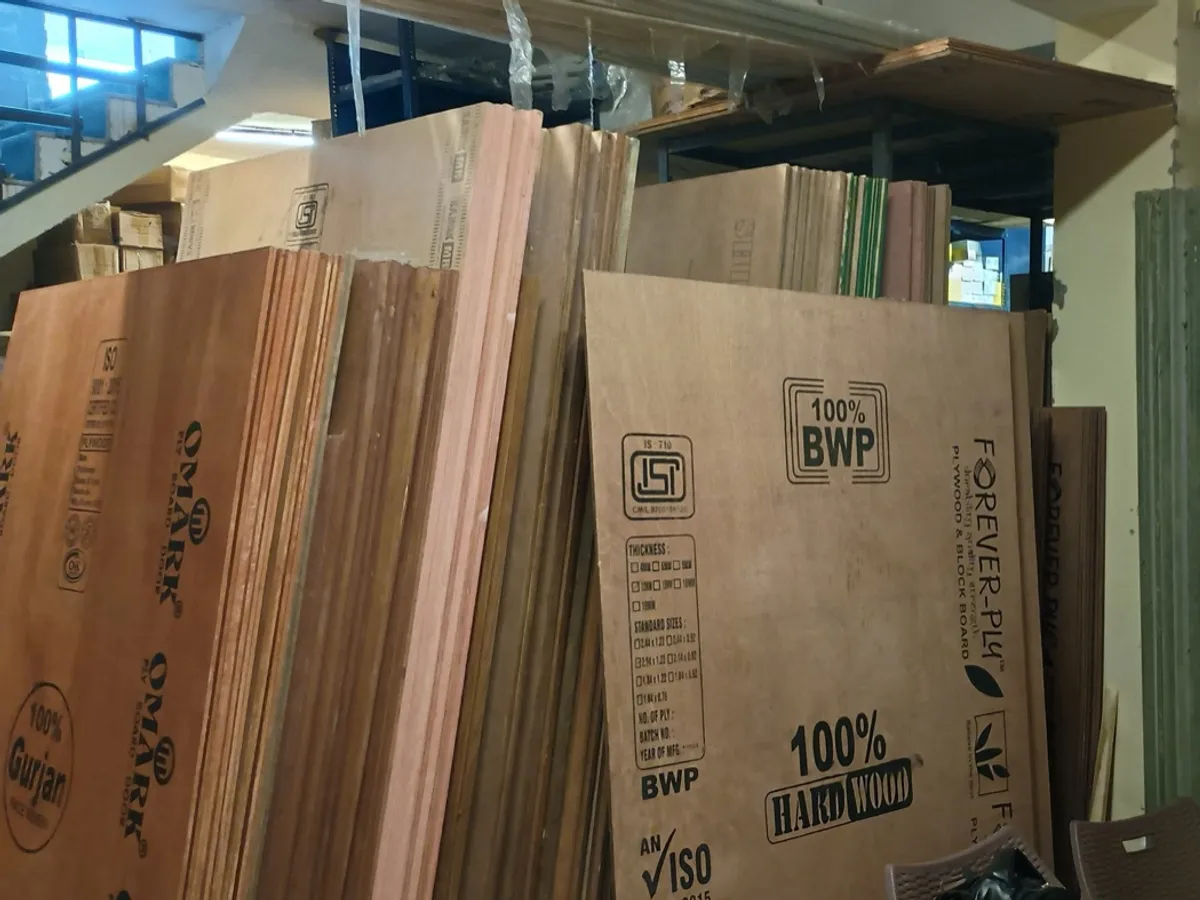
- Find the ISI mark and check that it names IS 1659 and the grade, MR or BWP.
- Look at the edge. The core strips should sit tight edge to edge, with no large gaps, loose pieces or filler.
- Sight along the length. A good board is flat and its edges are straight; reject a sheet that is twisted or bowed.
- Tap across the face. A hollow sound over a patch can mean a gap in the core below.
- Measure the thickness at a few points with a vernier, and ask for a GST bill that names the product, grade and thickness.
IS 1659 sets clear limits you can check against: thickness within 5 percent of the stated size, no more than 0.5 mm variation in thickness across one board, and edges straight and square to within 2 mm per metre. A board that is visibly thicker at one end than the other fails the spirit of that test.
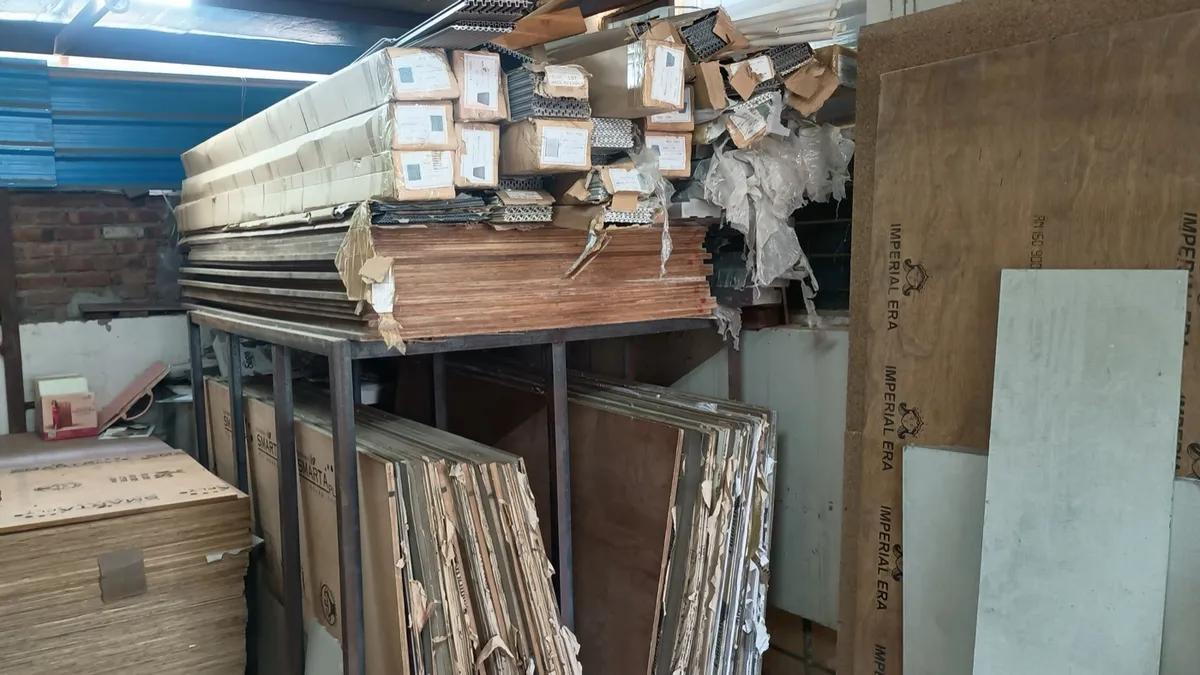
Sri Sri Plywoods has supplied Tricity homes since 1991 from showrooms in Mohali and Ambala; see the plywood section or ask an advisor at either showroom which board suits each part.
The Sri Sri Plywoods rule: let the part decide the board. Block board for long, flat doors and panels, plywood for boxes, drawers and anything with a tap nearby, and nobody should up-sell you one board for the whole job.