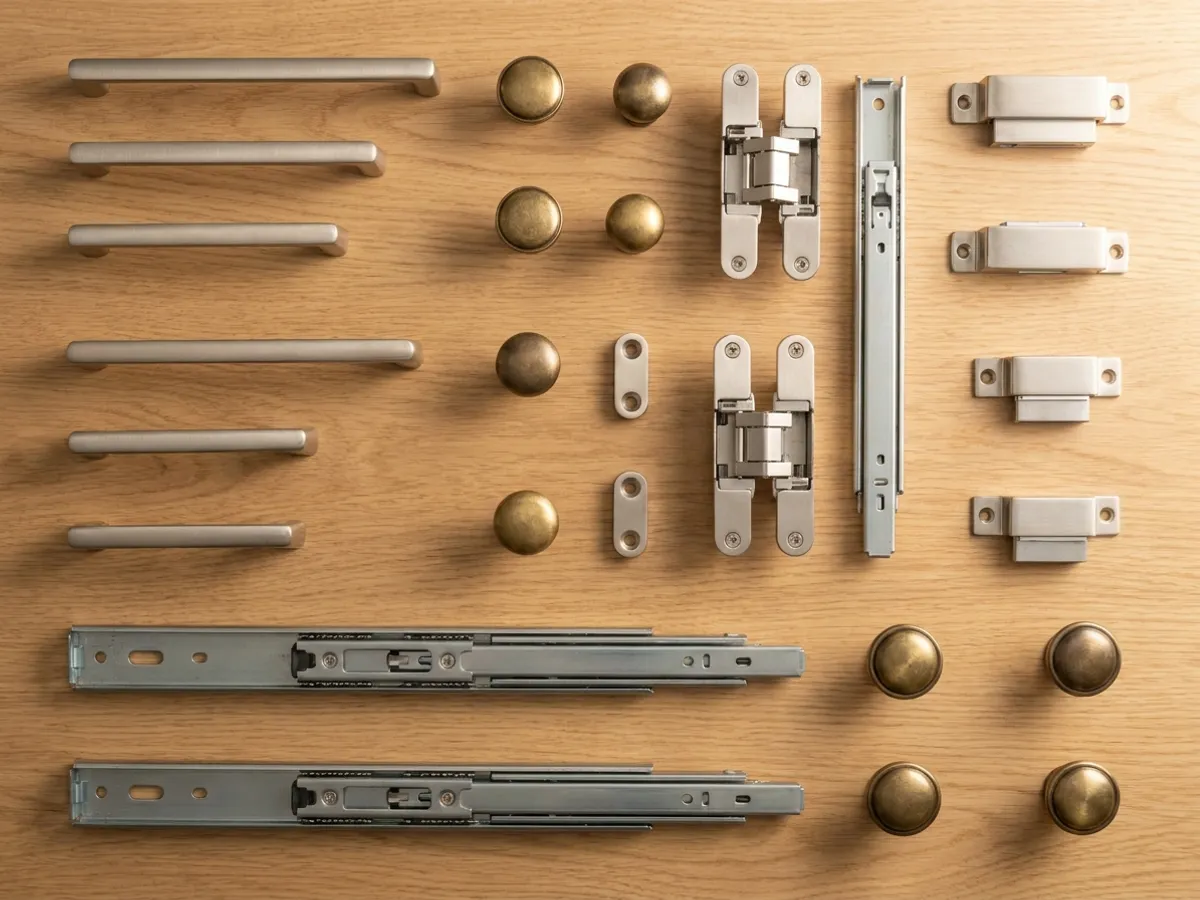
In this guide
- An auto hinge only springs the door shut; a soft close (hydraulic) hinge also damps the last part of the swing.
- The overlay type, not the cup, decides how the door sits: full overlay, half overlay or inset.
- Built-in damping is neater and adjusts with the hinge; add-on dampers can upgrade existing hinges.
- Use at least two hinges per door and more for tall or heavy doors, following the maker's chart.
- Test the hinge or channel on a mounted door or drawer before you buy, not in the box.
What are soft close hinges and how do they work?
Soft close hinges are concealed cabinet hinges with a built-in damper that catches the door in the last part of its swing and closes it slowly and quietly. An ordinary "auto" hinge only has a spring that pulls the door shut. Ask at Sri Sri Plywoods to try both on a mounted door and feel the difference.
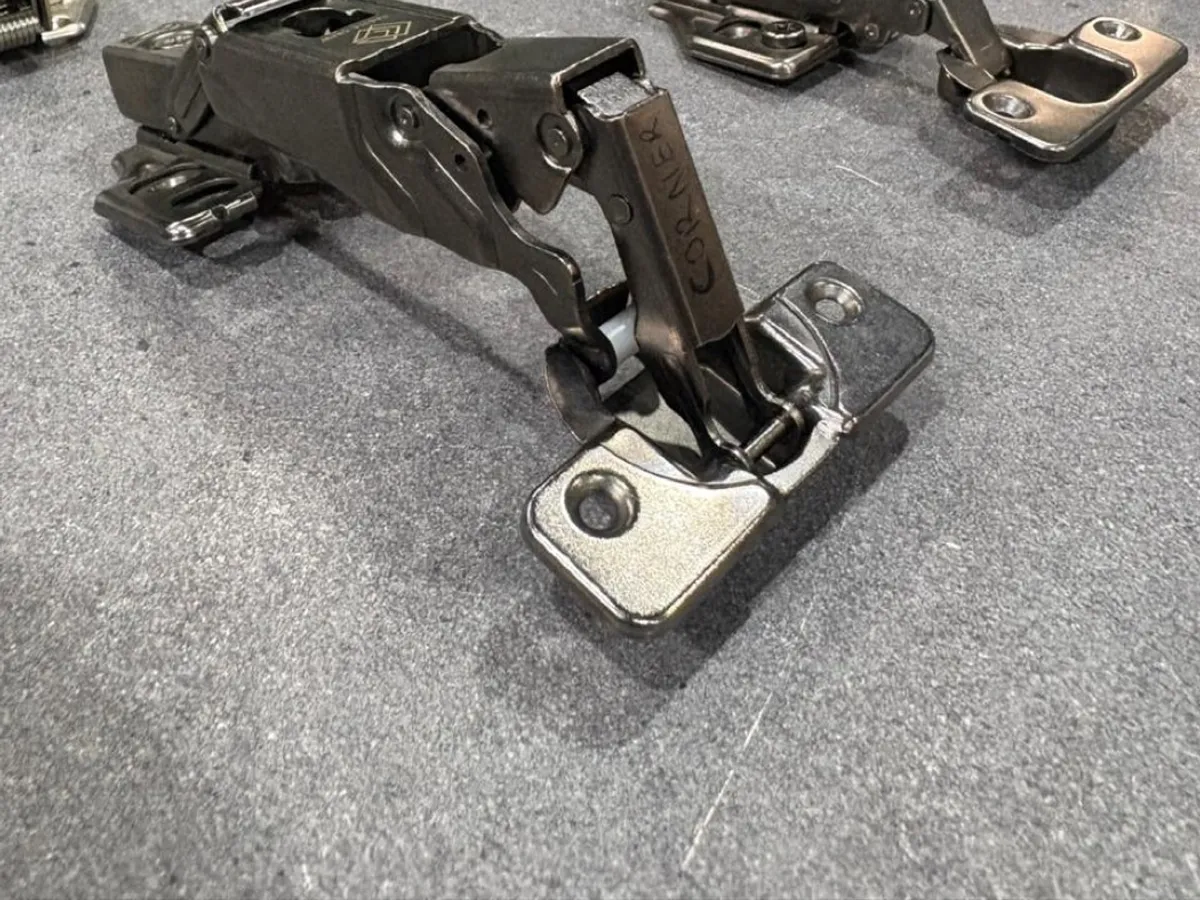
A concealed hinge has two parts. The cup sits in a round hole bored into the back of the shutter, and the arm clips or screws onto a mounting plate fixed to the cabinet side. On many ranges the cup is 35 mm across; Hettich's Sensys 110° hinge, for example, lists a 35 mm cup.
In Indian hardware shops you will hear three terms:
Spring only
Pulls the door shut once it is nearly closed. Cheaper, but the door can still bang if pushed hard.
Spring plus damper
Brakes the final part of the swing so the door closes gently, however hard it is pushed.
No handle needed
Press the door and it springs open. Used on handle-less kitchens; some versions also close softly.
Soft close earns its cost on the doors that get the most use and take the most punishment: base units next to the hob and sink, tall pantry shutters, and any door a child might swing shut. It also protects the shutter itself, because a door that slams every day slowly loosens its hinge screws and chips its edge-banding.
How do you choose the correct hinge for a cabinet door?
Choosing the correct hinge for a cabinet door starts with the overlay type, which decides how the door sits against the cabinet. It comes from the bend (crank) in the hinge arm, not from the cup. Hettich's Sensys, for example, is sold in overlay, half overlay and inset versions, and other brands offer the same three types.
| Overlay type | How the door sits | Typical use |
|---|---|---|
| Full overlay | Door covers the full front edge of the cabinet side | End doors and single cabinets |
| Half overlay | Two doors share one middle partition, each covering about half of it | Runs of cabinets that share a partition |
| Inset | Door sits inside the carcass, flush with its front edge | Framed or furniture-style cabinets |
If you are replacing a hinge, match the overlay type exactly. A full overlay hinge on a shared partition will make the two doors clash. Not sure which one you have? Look at the arm from the side: a straight arm is usually full overlay, a slight bend half overlay, and a deep bend inset. Or simply bring the old hinge along to the shop.
Built-in or add-on soft close: which is better?
Built-in soft close has the damper inside the hinge arm, so it adjusts with the hinge and looks clean. Add-on dampers are separate parts that clip onto a standard hinge or screw into the cabinet. Built-in is the neater choice for new kitchens; add-on is a practical way to upgrade existing hinges without changing them.
Hettich's Sensys, for example, has its damping built into the hinge arm, while its Intermat hinge can take the Silent System as an optional upgrade. Other brands offer similar pairs. With add-on dampers, fit the number the maker recommends: too many on a light door can stop it short of closing.
What opening angle and adjustment do you need?
A standard concealed hinge typically opens to about 110°. Hettich's Sensys 110° is one example. Wide-angle versions open further; Hettich lists a Sensys wide-angle hinge at 165°. Choose a wider angle when:
- Internal drawers sit behind the door and must slide out past it.
- A corner unit or pull-out basket needs the door fully out of the way.
- The door opens against a wall and must not hit it.
Adjustment matters as much as angle. A good concealed hinge adjusts in three directions: side (to line up the gaps between doors), depth (to pull the door tight to the carcass) and height. Hettich's Sensys 110° lists side and depth adjustment on the hinge and height adjustment on the mounting plate. Clip-on hinges, such as Sensys, snap onto the mounting plate, so doors can be removed for cleaning or repair and put back without resetting.
Check the door thickness too. Hettich lists the Sensys 110° for doors from 15 to 24 mm thick, which covers most 18 mm laminated and PU shutters. Thicker doors, profile doors and glass doors need hinges made for them.
Choosing hinges?
Get a free quoteHow many hinges does a cabinet door need?
Most cabinet doors need at least two hinges. Tall doors, wide doors and heavy materials such as glass or thick panels need three or more. The exact number depends on the door's height, width and weight, so follow the manufacturer's chart. Hettich, for example, publishes a "number of hinges per door" planning guide.
Three things push the count up:
- Height. Full-height wardrobe and tall-unit shutters need extra hinges to stay straight.
- Weight. Glass, mirror and thick solid panels load each hinge more.
- Width. Wide doors lever more force onto the top hinge.
Too few hinges and the door sags; the soft close then drags and stops working well. When in doubt, add one more hinge.
Glass and mirror shutters need their own hinge type, because there is no wood to bore a cup into. Hettich's Avosys, for example, is a concealed hinge made for glass and mirror doors, with integrated soft closing. Ask for the glass thickness the hinge is rated for before you order the shutter.
What should you check when buying soft close channels?
Soft close channels, also called runners or drawer slides, follow the same logic as hinges: the damper should be built in, and the load rating should exceed what the drawer will hold. Ebco's Sleek telescopic slide, for example, lists soft closing built into the slide, full extension and a 35 kg load capacity.
| Check | What to look for |
|---|---|
| Extension | Full extension lets you reach the back of the drawer; partial extension leaves part of it inside |
| Soft close | Built into the channel, not an add-on catch |
| Load rating | Stated by the maker; choose a class above the drawer's real contents |
| Side clearance | Side-mounted channels need a gap each side; Hettich's KA 4532 lists a 12.7 mm installed width |
| Length | Matched to the cabinet's internal depth |
For the full comparison of side-mounted telescopic channels and concealed undermount systems, read telescopic vs tandem drawer channels.
How do you test soft close hardware in a showroom?
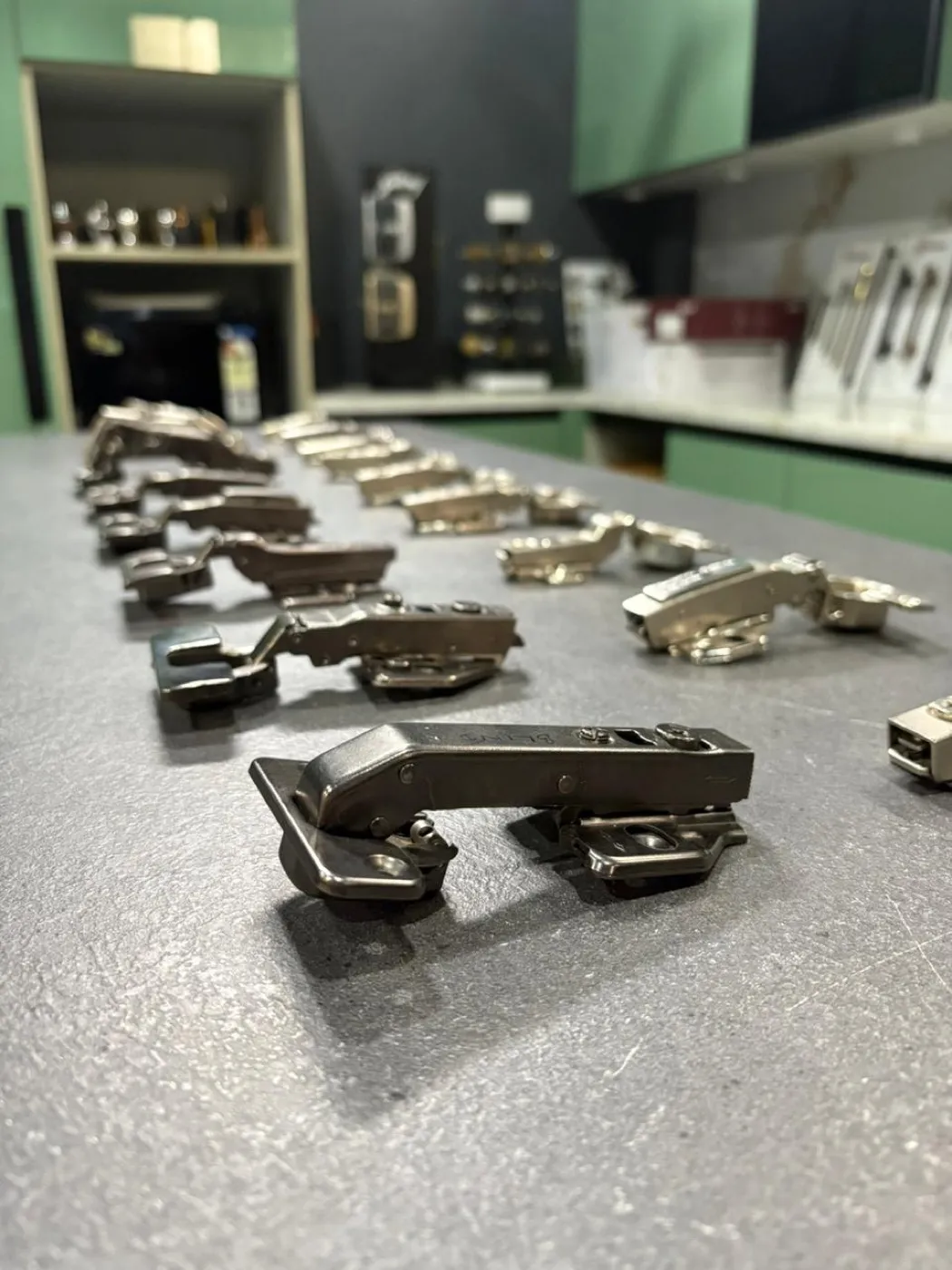
Never judge a hinge or channel in its box. Test it mounted on a real door or drawer, as on the hardware displays at Sri Sri Plywoods. Bring your door sizes and a photo of the cabinet, so the advisor can point you to hinges that match.
- Slam test. Push the door or drawer shut hard. It should slow down and close quietly, without bouncing back.
- Gentle test. Push it lightly. It should still close fully, not stop a few millimetres short.
- Full swing. Open the door to its full angle and check it clears any drawer or basket behind it.
- Wobble test. With the door open, lift its outer edge gently. There should be no play at the hinge.
- Adjust. Turn the side and depth screws. They should move the door smoothly and hold their setting.
- Clip off and on. Remove and refit a clip-on hinge. It should click back in the same position.
- Read the label. Note the brand, range, overlay type, opening angle and load rating, and ask for them on the bill.
Planning a whole kitchen? Our comparison of Hettich vs Häfele vs Ebco covers how to choose between brands, and our modular kitchen team fits the hardware as part of the build.
The Sri Sri Plywoods rule: put built-in soft close on every door and drawer you use daily, and save on lofts you open twice a year. Test before you buy, and keep the product names on your bill.